
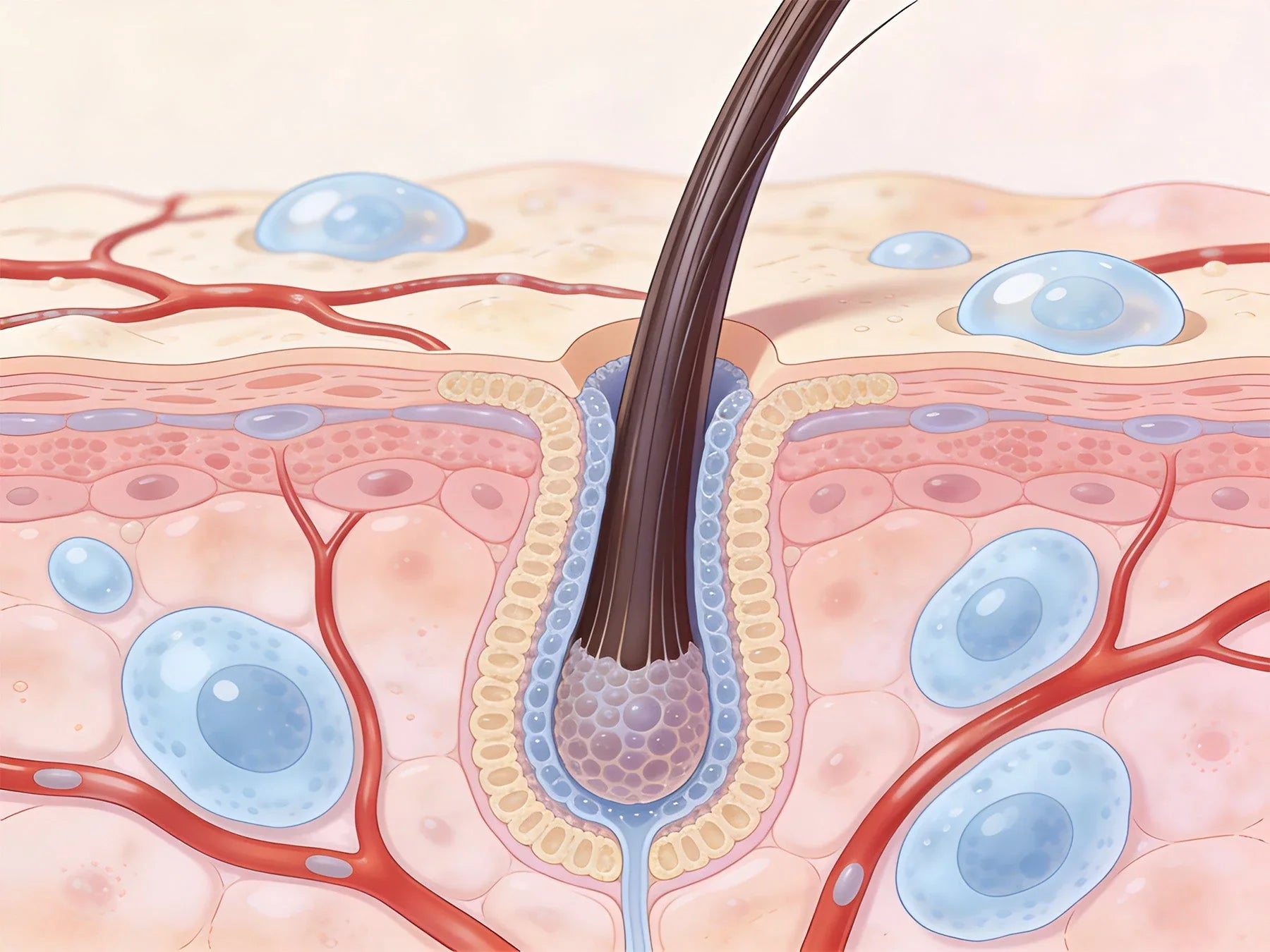
AHK-Cu: The Copper Peptide Targeting Hair Follicle Research
If GHK-Cu opened the door to copper peptide research in skin and collagen science, AHK-Cu is the compound walking through it with one specific target in mind: the hair follicle. For researchers focused on hair loss and regrowth models, this is the peptide currently generating the most interest.
What Is AHK-Cu?
AHK-Cu (Copper Tripeptide-3) is a synthetic peptide built from three amino acids — alanine, histidine and lysine — bound to a copper ion. It is a structural cousin of GHK-Cu, but where GHK-Cu has been studied broadly across skin remodelling, collagen synthesis and antioxidant pathways, research on AHK-Cu has clustered far more tightly around one area: the biology of the hair follicle.
That focus is what makes it interesting. For research groups working specifically on androgenic alopecia models, follicle elongation, or dermal papilla cell behaviour, AHK-Cu is a compound built for the question being asked.
3 Key Areas of AHK-Cu Study
1. Hair Follicle Elongation
The headline area of investigation. In vitro research has examined AHK-Cu's effect on the hair follicle directly, looking at follicle elongation and the prolonging of the anagen (growth) phase. Studies in this space have observed AHK-Cu encouraging measurable follicle growth in cultured models, which is why it has become a reference compound for hair regrowth research rather than a general dermal peptide.
2. Dermal Papilla Cell Research
Dermal papilla cells sit at the base of the hair follicle and are central to the signalling that governs whether a follicle grows, rests, or sheds. Research has investigated AHK-Cu's influence on the proliferation and viability of these cells in vitro. For researchers modelling the mechanics of thinning and regrowth, dermal papilla behaviour is the engine room, and AHK-Cu is being studied as a compound that may act on it.
3. VEGF and Vascular Signalling
Healthy follicles need a healthy blood supply. AHK-Cu has been examined in research settings for its relationship with vascular endothelial growth factor (VEGF), a signalling protein tied to the formation of new blood vessels. Studies exploring follicle support models have looked at AHK-Cu through this angiogenic lens, investigating whether improved vascular signalling forms part of the picture.
AHK-Cu and GHK-Cu: Sister Compounds, Different Focus
Researchers familiar with our GHK-Cu will recognise the family resemblance. Both are copper-binding tripeptides. Both are studied in the broad field of regenerative and dermal research. The practical difference is one of emphasis: GHK-Cu's research base is wide, spanning collagen, elastin, antioxidant action and follicle science together. AHK-Cu's research base is narrow and deep, concentrated on the follicle.
For a research programme looking specifically at hair, that specificity is the point. Many laboratories investigate the two in parallel.
The "Tide Labs" Purity Check
Handling matters with copper peptides. AHK-Cu is a copper complex, and the stability of the copper-peptide bond depends on how it is stored and handled. Exposure to acidic buffers, heat, or poor storage can destabilise the complex before research even begins.
At Tide Labs, our AHK-Cu is supplied as a lyophilised powder in Type 1 hydrolytic glass vials, HPLC tested by a UKAS and ISO 9001 accredited UK laboratory, and held at -20°C in medical-grade freezers to keep the copper-peptide bond intact. It is reconstituted with bacteriostatic water for research use, and our full cold chain logistics mean it reaches your bench in the same condition it left ours.
AHK-Cu is supplied strictly as a research material. It is not for human or veterinary use.


