
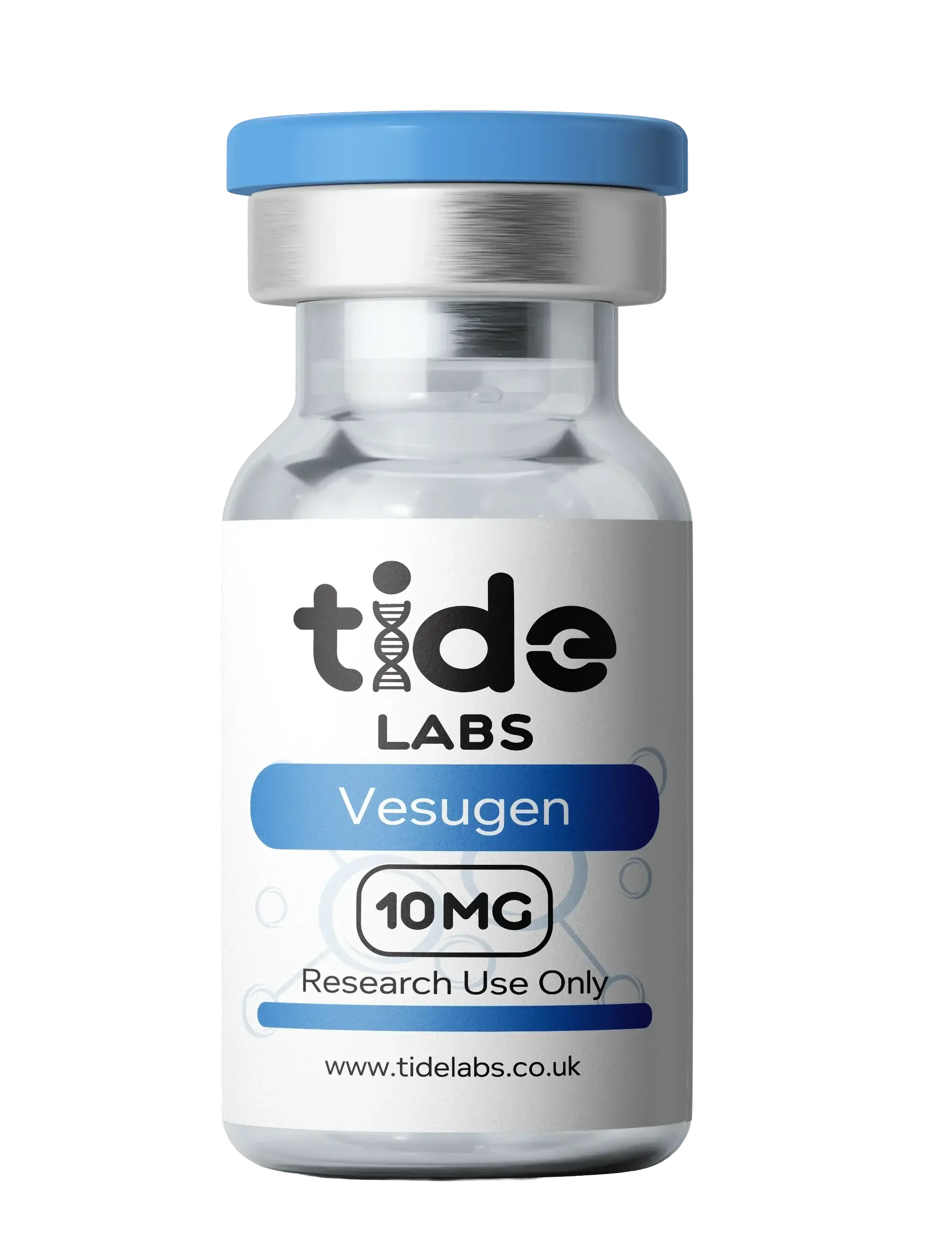


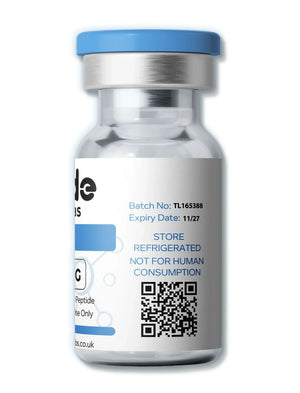

Vesugen
Certificate of Analysis (COA): See Images
Vesugen (Lys-Glu-Asp) is a synthetic research tripeptide and a vascular-associated member of the Khavinson family of short peptide bioregulators. Derived from a sequence related to vascular wall proteins, Vesugen has become an exciting subject of study in preclinical research, particularly in areas related to vascular endothelial cells, gene expression, and neuronal signalling. While not approved for human or veterinary use, Vesugen continues to generate strong interest as a promising candidate in laboratory and academic research settings.
Area of Interest
Research on Vesugen has focused on several areas of interest:
- Vascular Endothelial Studies: Investigated in preclinical models for its influence on the proliferation and behaviour of vascular endothelial cells, the cells that line blood vessels.
- Gene Expression Regulation: Studied for its ability to influence tissue-specific transcriptional activity, including reported effects on endothelin-1 and connexin expression, a defining characteristic of the Khavinson bioregulator family.
- Neuronal Spine Density: Examined in primary hippocampal neuron cultures, where research reported an increase in mushroom spine density under synaptotoxic conditions.
- Geroprotective Research: Explored as an ultra-short peptide of interest in studies of age-associated vascular change and cellular homeostasis.
Together, these studies position Vesugen as a distinctive ultra-short bioregulator. It is frequently investigated alongside related Khavinson peptides such as Cortagen and Pancragen, reflecting its potential as an exciting area of discovery in peptide bioregulation.
Technical Information
- Chemical Name: L-Lysyl-L-α-glutamyl-L-α-aspartic acid
- Synonyms: KED, T-38, Lys-Glu-Asp
- Molecular Formula: C₁₅H₂₆N₄O₈
- Molecular Weight: 390.39 g/mol
- Sequence (Amino Acid): Lys-Glu-Asp (KED)
- CAS Number: 204271-66-9
- Peptide Classification: Synthetic Khavinson short peptide bioregulator (tripeptide)
Storage Guidelines
- Lyophilized peptide is stable at room temperature for several weeks.
- For long-term storage, keep at −20°C or below.
-
Once reconstituted, store at 2–8 °C. Effective use depends on the solution used.
Solubility
Vesugen is soluble in bacteriostatic water and other aqueous buffers depending on purity and formulation.
References
- Khavinson, V. K., Kuznik, B. I., & Ryzhak, G. A. (2013). "Peptide bioregulators: a new class of geroprotectors." Advances in Gerontology, 3(3), 225–235. https://doi.org/10.1134/S2079057013030089
- Kraskovskaya, N. A., Kukanova, E. O., Lin'kova, N. S., et al. (2017). "Tripeptides Restore the Number of Neuronal Spines under Conditions of In Vitro Modeled Synaptotoxicity." Bulletin of Experimental Biology and Medicine, 163(4), 550–553. https://pubmed.ncbi.nlm.nih.gov/28853087/
- Khavinson, V. K., Lin'kova, N. S., Polyakova, V. O., et al. (2012). "Peptides tissue-specifically stimulate cell differentiation during their aging." Bulletin of Experimental Biology and Medicine, 153(1), 148–151. https://doi.org/10.1007/s10517-012-1664-1
Vesugen
The Difference Is Clear
Tide Labs vs. Typical UK Suppliers
Most UK peptide suppliers cut corners on testing, storage, and documentation. Here's what sets us apart.